• Skip to primary navigation
  • Skip to main content

Jack Walton

Home on the web

  • Home
  • Read
  • Music
  • Collaborate
  • About
  • Show Search
Hide Search

Archives for September 2023

Reading is writing

Jack Walton · September 12, 2023 ·

Something I feel to be very true for myself is that reading sits at a very marginal distance from writing.

What I think I mean by that is this: taking in sensory inputs (e.g. reading off a page) produces responses (thoughts, sensations, etc.), which is basically writing without going to the step of recording those things.

One way to direct that sprint is to feed my intuition with some sort of content to react to. It’s the same principle as a ‘reacts’ video on YouTube/TikTok/Instagram, except I’m reacting onto the page.

I made the point in the last post that a writing sprint is an opportunity to have a close experience of ideation. Setting up a prompt or comment to react to is also a good self-learning opportunity, since it might lead us to question what that prompt really means.

Here’s one I used yesterday:

The importance of semiotics for all disciplines that deal crucially with representation (among them epistemology, linguistics, anthropology, and cognitive science, and probably all the fine arts) is only beginning to be recognized.

Nathan Houser, foreword to The Essential Peirce, p. xxi

Prompts needn’t be text necessarily—they could be environments, future engagements, people, physical states (try sprinting down the street before you sprint on the page).
One Pomodoro

Jack Walton · September 11, 2023 ·

This week I’m running a regular writing session for a few people—the idea is that we meet online at 8am for a 30 minute writing sprint.

With 5 of those minutes allocated for chatting at the start/end, this is about 25 minutes of solid writing time (or one repetition of the Pomodoro technique).

The rules of the sprint are simple: write as much as you can (ideally set an aspirational word count), and do not (do not!) go backwards—this is about having thoughts, not perfecting prose. I managed 1017 words this morning; one of the others punched out 1300.

Why should we accept word count as a decent metric for this sort of exercise? One reason has to do with probability; the more we write the more we are likely to come across a few diamonds in the rough.

The more interesting reason is that setting a clear target in combination with the suspension-of-editing-rule (i.e. not going backwards) means that we are forced a little more directly to channel ‘who we are’ in our writing.

This exercise isn’t just about generating content (though that’s a nice byproduct). Rather, it’s a chance to participate in knowledgeable ideation, which is possible because we, as writers (or creators of any sort really) are not tabulae rasae writing into the void.

How to cultivate an idea ecosystem

Jack Walton · September 3, 2023 ·

Ideation is the process of idea-having—it matters because ideas have a massive influence on what we do with our time (even how we experience it in the moment). The first section of this post contains some philosophical thoughts; skip ahead for the tools.

My philosophy of ideation (in brief)

Ideation is also an important part of ‘getting started’, and it’s trendy right now to to try using AI to kickstart this. Although that works (to an extent), I think ideation is still something worth practising for ourselves.

Why? Because we need to have ideas all the time—preferably good ones.

The great thing about conscious ideation is that it can happen anywhere, and it feeds almost automatically on whatever we do with our time (what we read, conversations we have, work we experience, etc.). The technical challenge is logging all this stuff in a low-friction way (i.e. staying in motion).

To my mind it’s helpful to think about ideation as a kind of ecosystem; a kind of ‘garden‘ of agents and artefacts that influence the ideas that are had and how they are captured and/or used. This concept goes beyond ‘knowledge management’ to address the fact that we likely want to make something with the material that we accrue, and that there is a whole host of other factors at play (e.g. how we feel on a given day, whatever agenda our collaborators or gatekeepers might have).

The ‘agents and artefacts’ of the ecosystem don’t just include physical things—concepts have an influential presence too. Notably, a theory of drafting provides some scaffold for refining raw materials, and without a concept of publishing (/implementation/shipping/delivery) the ecosystem probably won’t deliver much to the outside world. Publishing is especially important because it feeds ideation by opening space for ‘what’s next’.

Tools for implementing conscious ideation

The point of conscious ideation is to prospect for worthwhile ideas, and a carefully cultivated ecosystem helps these ideas to flourish.

This is the stack of tools I use to keep things going:

  • Obsidian for writing and general idea management (this one is probably my ‘everything’ app)
  • Notion as an Obsidian alternative for collaborative projects (or if I need a prettier alternative to Obsidian)
  • Word for formatting things nicely when necessary
  • Zotero for referencing
  • Readwise/Reader for aggregating highlights and remembering what I’ve read (experimenting with this; I used Devonthink religiously until very recently)
  • Kindle + Audible synchronised via whispersync where possible for books (I don’t like reading books on a device; but having the book read aloud with Kindle allows for easier highlighting)
  • Snipd for podcasts (mainly because it synchronises with Readwise)
  • Google drive for file storage
  • Logic Pro for recording muisc and other audio work
  • Apple voice memos for capturing audio away from the computer
  • Midjourney for image creation (e.g. the logos on this site)
  • Pens and paper everywhere (literally everywhere, even a waterproof notepad for shower thoughts)

Four dimensions of a writing practice

Jack Walton · September 2, 2023 ·

I’ve written a bit recently about the subjective aspect of writing (see How to find writerly mojo, A way to write)—a few friends have questioned why I seem to be downplaying the technical side of things.

One of the reasons I’ve written less about technical specifics of writing has to do with the amount of attention already paid to that side of things (…or maybe I just hang out with more linguists than most). It’s a fair point though, and it got me wondering how I see writing from a more holistic standpoint. How can we think about the the different parts of its ‘make up’?

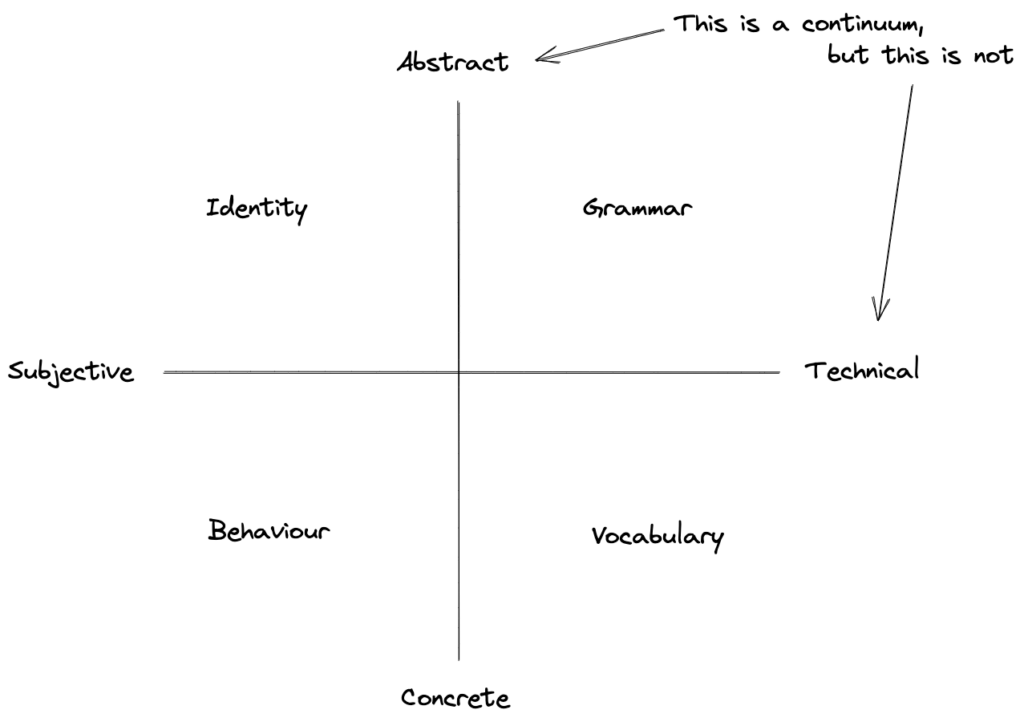
The diagram below is an attempt at laying out two facets of writing I think about a lot. The horizontal axis is a typology that distinguishes between a focus on the writer (the subjective side of things) and a focus on the writing (the technical side of things).

The vertical axis can help us to see different ways of placing subjectivity and technicality—the top side of the plane has to do with more generalised versions of these concepts, while the bottom side of the plane is a prompt to think about their concrete counterparts.

One way to use this tool might be as something of a diagnostic reflective device—for example, thinking about these dimensions might help us to see if we’re trying to solve an identity problem with vocabulary.

These ideas owe a fair bit to my exposure to LCT—you can check that out here.